May 02, 2014

A Day by Manila Bay


After a particularly interesting cab ride, I made my way up to my hostel. There were two Israeli girls in my room who had also recently arrived. They had just wrapped up their mandatory tour of duty with the Israeli defence service and were beginning a 3 month journey across Southeast Asia before heading to university. Israel, like South Korea, is surrounded by enemies on all sides and utilizes conscript soldiers.


Israeli youth over 18 are required to serve in the military. Guys have to serve for at least 3 years, while gals have a minimum 2 year term. The former soldiers invited me to join them on their exploration of Manila. I was spending a few days in the capital city before jetting off to the island of Palawan to catch up with my Dutch friends, so I headed out with them to get my first taste of a new city and a new country.


There are two modes of mass rail transportation in Manila. We took the MRT to Taft Avenue, and then transferred to the LRT all the way to United Nations station. As we went down the station stairs an elderly Filipino gentleman approached us and cautioned the girls to wear their backpacks in the front, so that no one would have a chance to unzip the bag from behind and empty it of its valuable contents. We would find out how much weight his warnings carried later on as we walked towards nearby Rizal Park. A child appeared to be tying his shoelaces in front of us. Suddenly he leapt up and buzzed past us. One of the girls let out a yelp. Her necklace was gone! Our eyes followed a blur zigzagging through the heavy traffic to the other side of the street and disappearing, never to be seen by us again.


“I thought having a guy around would have kept us safe, but apparently I was mistaken” groused the girl whose neckless had been pilfered. I maintained my silence, but not my dignity. Our spirits soon lifted as we headed into the park, packed with Filipino families celebrating the first day of 2014. We tried a variety of the snacks and drinks being sold at the stalls peppered throughout the length of the park. My favourite was the buko shake, a coconut smoothie designed to beat the heat.


The eponymous Dr. José Protacio Rizal Mercado y Alonso Realonda, or José Rizal in short, was a national hero, scholar, poet, and revolutionary who knew 22 languages and dialects (or about 21 more than the average number known by a Korean). His execution by firing squad on the grounds of the park later named after him ignited the Philippine Revolution against Spain. Kilometre Zero, the point in Manila from where distances are traditionally measured in the Philippines, is also located within the park. The flag of the Philippines proudly waved from atop a massive flagstaff at one end of the park. From there a short walk led us to Manila Bay and a lovely sunset.


*****

It is a useless life that is not consecrated to a great ideal. It is like a stone wasted on the field without becoming a part of any edifice. ~ Jose Rizal

April 29, 2014

Conversations with Cabbies: Gastronomy


On the first day of 2014 I made my way to the Philippines from South Korea. As I exited the Manila's Ninoy Aquino International Airport I was met with a long snaking lineup at the taxi counter. Not many taxis were around as it was a public holiday. I eventually made my way to the front of the line and caught a cab. The driver immediately engaged me in conversation, a form of verbal interchange I had become unfamiliar with after living in Korea.

Upon inquiry, I told him that I was going to meet up with some friends in the Philippines and travel around. “Did you come here to meet a lady friend. Lots of foreign man come to Philippines because they like our ladies”. I replied in the negative, as my travel buddies were two Dutch men. He let out a loud juicy fart and apologized “Sorry! Gastronomy”.

We also discussed my travel plans, our educational background, career paths, job prospects, and the notorious behaviour of Korean men in the nation. Kopinos (코피노) are the byproduct of illicit liaisons between Korean guys and the Filipinas who these men have either paid or misguided. There are now over ten thousand of these fatherless children scattered across the Philippines. A coalition of mothers has even made their way to Korea to demand child support money from the fathers, who either do not know or do not want to know about their spawn.

The taxi driver also told me he had an ex-Canadian girlfriend who he had met when she had accompanied his sister (who works as a nurse in Canada) on a trip back to the Philippines. They had a long distance relationship for a few months until she dumped him unilaterally. “Why are Canadian girls so mean?” he asked me. I struggled to give an adequate answer, mumbling “I don't know. Are they mean?” and “I’m not sure it’s a trait particular to Canadian girls”. "They are moody like a smoothie!" he exclaimed as we passed a 7-11 convenience store.

The name of my hostel in Manila was Our Awesome Hostel, located in a poor neighbourhood outside the gates of modernity. The cabbie parked outside the entrance, took one look, and immediately declared "This is definitely not awesome".

April 11, 2014

Urinal Etiquettes

Although I had some ghastly experiences in Chinese toilets, most of my memories are happy ones. I much enjoyed reading the words of wisdom posted above urinals all over China, from the succinct "Closer, easier" to the more verbose "You can enjoy the fresh air after finishing a civilized urinating". I was heartened to see that the Chinese visa processing office in Vancouver maintained the tradition with a similar sign posted at its bathroom facilities.


The urinal etiquette instructed the user to maintain eye contact with the urinal at all times, and not chit chat or look at neighbours while taking a leak. The user generated stream also had to be parallel to the Earth's surface. Physics experiments, particularly those involving parabolic trajectories, were strongly discouraged.

*****

“I just peed in the sink. Why? Because there was already somebody in the bathtub.
” 
― Jarod Kintz

April 04, 2014

It is Suck

In South Korea, conformity is the name of the game. Anything that deviates from a very limited spectrum of acceptability is scorned, particularly when it comes to matters of appearance and style.

Me: My jacket is very nice.

Korean coworker: No, it is suck.

April 03, 2014

Zhengzhou - China's Largest Ghost City


With their empty streets and their deserted buildings, ghost towns have always fascinated me . Desolate and decaying constructs leave a physical reminder of glory days that have been swept away by the winds of destiny, disuse, and destruction. Living in Asia provides access to a particular phenomena - that of modern day ghost towns built in anticipation of a demand that may or may not materialize.


Some are worthy experiments in city building while others are entertaining combinations of vanity project and investor folly. China is in the lead with Ordos and Zhengzhou, followed by South Korea's Songdo. India has contributed deserted Lavassa, a holiday resort within driving distance of Mumbai and Pune but with around 0.01% of their population density.


As one of the eight ancient capitals of China, Zhengzhou itself has a long history. Recent archaeological excavations have revealed that it was the first city of the Shang dynasty around 3500 years ago. After visiting several heads of states, my friend Swathish and I made our way to the outskirts of the capital of Henan to visit the Middle Kingdom's largest ghost city - Zhengzhou New District.


Although Zhenghou's urban population base is nearing 9 million, not many of its inhabitants had made it to the New District. Swathish and I wandered through the deserted boulevards undisturbed. 'Caution for tumbling' warned a sign beside a staircase in front of an empty convention center and museum complex. Although mostly unused and uninhabited, the office towers, apartment complexes, and civic spaces showed heavy investment.


Rent is supposedly excessive even though tenants are hard to come by. One area is named Vancouver Square. The ghost cities are a testament to a future that is desired by the powers that be, but not one that is necessarily a reflection on the present day capabilities or desires of the populace.


Unlike Ordos, which is a lengthy highway drive away from its older namesake, new Zhengzhou is a modern, well-planned continuation of inhabited Zhenghzhou, so there is a greater likelihood that it will soon transform into a functioning community.


Apart from the short term gains that are generated by a resource and manpower intensive project like building a city from scratch, the grand vision of Zhengzhou New Distract may yet become a reality as migrants and businesses slowly trickle into a settlement where the infrastructure is already in place to handle an increasingly urban and affluent population.


*****

Civilization is the limitless multiplication of unnecessary necessities. ~ Mark Twain

March 14, 2014

Colombo's Bat Park


Perhaps one of the stranger sights I witnessed in Colombo, apart from a solitary white woman who expertly used only her hands to devour a meal served on a banana leaf at a traditional Sri Lankan eatery, was a park in the middle of the city filled with hundreds of bats. Multitudes of these webbed mammals were roosting high above me on the branches of several trees clustered in the centre of Viharamahadevi Park on a sunny afternoon. 


I looked up with curiosity, but also frequently down at my feet to establish the path I should follow to avoid an undesired coat of bat guano. Using my powers of probabilistic reasoning to ward of danger, I tiptoed my way around the heavily splotched sections on the ground and maintained a brisk pace to avoid being pelted by any dastardly droppings. 


I was astounded by seeing so many of these creatures of the night out in pure daylight, as usually I only encounter them in caves or other dimly lit locations. I escaped unharmed and later found out that they are fruit bats of the Indian Flying Fox variety, addicted to fruit juice and capable of swallowing pieces of fruit in their entirety. 

February 17, 2014

Kaziranga - The Land of Rhinos

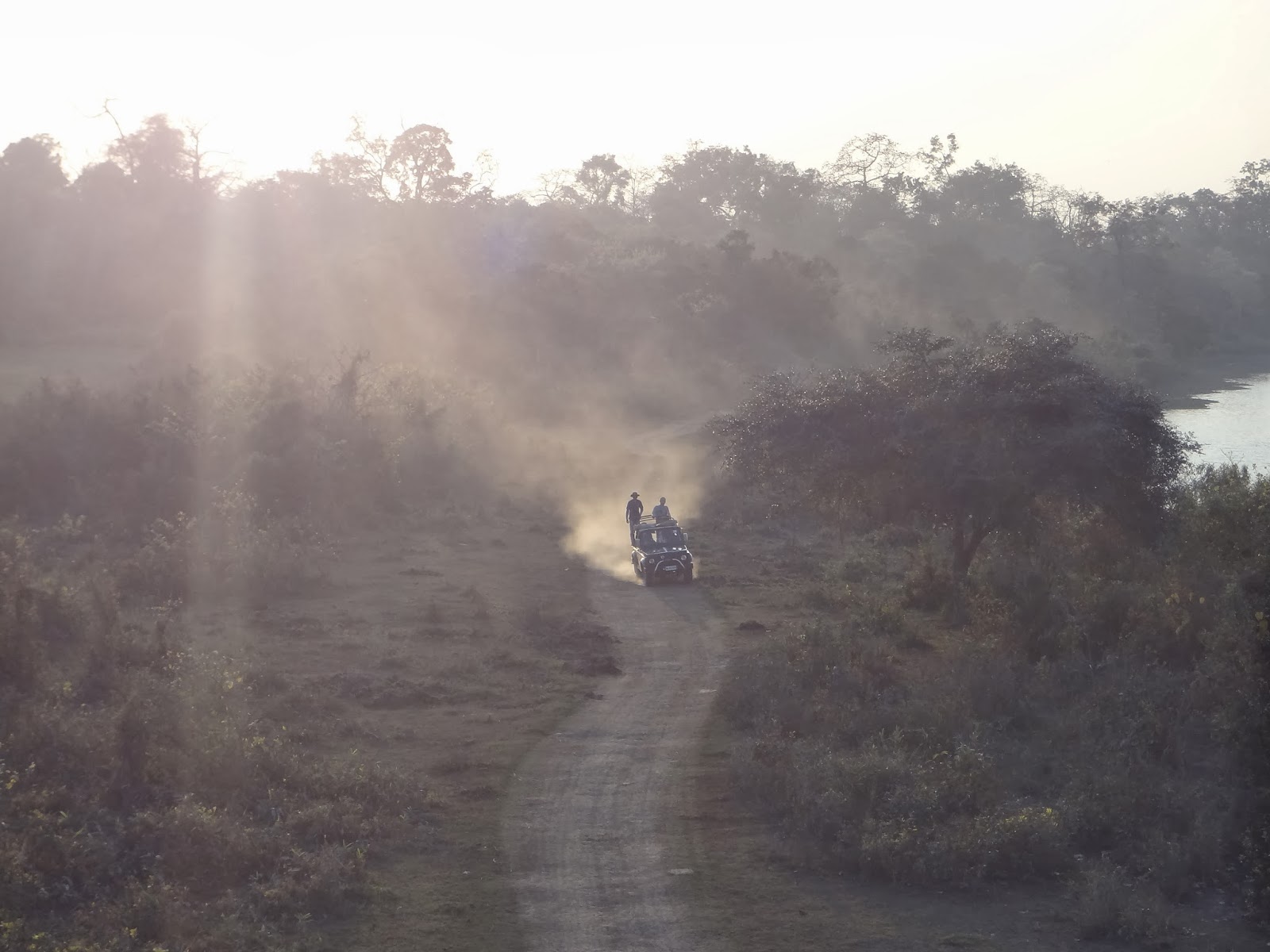
Kaziranga National Park and Tiger Reserve in Assam is famed for being home to two-thirds of the one-horned rhino population and having the highest ecological density of tigers of any protected area in the world. Elephants, water buffaloes, wild boars, deer, monkeys, turtles, migratory birds, and other wildlife are also present in significant numbers in the 450 square kilometre World Heritage Site. During monsoon season, the park is closed to visitors.


I headed from Guwahati to Kaziranga on an Assam State bus, handing my phone to the driver so the manager of the jungle lodge where I would be spending a few nights at could tell him exactly where to drop me off. I was deposited on the side of the street in the dark and told to wait. Soon after, I saw a light moving towards me from 200 meters away. It solidified into a boy holding a flashlight who guided me to my tent at the nicely maintained Nature Hunt Eco Lodge.


After dinner and some drinks with fellow guests around a campfire, I headed back to my tent. The same boy who had retrieved me from the road ran towards me yelling ‘Leopard! Leopard! Come see!’. I did not have a strong inclination to head in the direction of a leopard, but the boy was particularly enthusiastic so I followed him. He pointed his torch into the trees above and pointed to a civet among the branches. It was a significantly smaller jungle cat than a leopard.


The next day I woke at 530 am to go on an elephant safari. The start point was a half an hour jeep ride away from the lodge. I sat atop the elephant. The giant beast slowly ate its way through the grasslands, stopping at the behest of its mahout whenever rhinos or other wildlife were within breathing distance.


After pulling over at the side of the road on the way back from the jeep safari for a quick halt at a roadside temple, the driver told a story about why he prays for safety to the gods every day. Apparently the week before a rhino had munched on the front wheel of a jeep, then continued up until the windscreen, at which point he tossed the car sideways, flinging the passengers of the vehicle to the nearest hospital. The rhino had also hurt his neck in the incident.


I also heard a story of a tiger attacking a forest ranger within the national park. Another ranger rushed to his defence and shot the tiger, but he was punished. The law states that it is illegal to harm tigers, even for self defence, as Kaziranga is their natural habitat and it is humans that are encroaching on their territory.


In the afternoon I went on 3 hour open air jeep safari, spotting pretty much everything but a tiger. The driver did point out fresh tiger prints on top of the tire tracks of the last jeep that had passed the area, and trees where tigers had left claw marks.  I was surprised to hear that rhinos could achieve speeds of up to 40-45 km/h, similar to the pace K-girls can reach when they detect me in their vicinity. We had a few close calls with charging rhinos and protective mother elephants but the driver was always quick on the accelerator to keep us out of harms way.


*****

The only way to save a rhinoceros is to save the environment in which it lives, because there's a mutual dependency between it and millions of other species of both animals and plants. ~ David Attenborough

February 04, 2014

Monkey King

I was having lunch at Hai Di Lao, my favourite hotpot restaurant in Shanghai. The broth can splatter onto diners, so a range of protective accessories from aprons to cellphone covers and hair bands are provided to patrons. 

Pretty Chinese Girl: Here is hair band for your head. Oh, I forgot you don’t have hair there anymore! Hahahahaha. Anyway, you can use it for your hairy back then. 

Me: Korean girls don’t like my hairy body.

PCG: No girl like it.

Me: Maybe Latin ones? I’m not sure.

PCG: If they like monkey.

January 29, 2014

Dance Wance

Me: This year I need to find a job, meet a girl, get some muscles, and learn how to dance.

Pretty Chinese Girl: The dance is impossible.

Me: Why!? Maybe it is hidden inside of me somewhere...

PCG: Must be very deep inside then.

January 26, 2014

Handsome & Judgmental

Pretty Chinese Girl: You always say white man, black man, pretty girl, ugly girl. You are very judgmental. 

Me: Handsome judgmental man.

PCG: Handsome does not belong anywhere near you!

January 24, 2014

Horse

Pretty Chinese Girl: Wow! Your nose holes are enormous. Just like a horse!

Me: That’s not the only thing that’s like a horse.

PCG: The nose holes must take forever to clean.

Me: Or many fingers…

PCG: At least two can fit inside at once!

January 19, 2014

A Difference of Opinion

I had a layover in Shanghai, and briefly met up with a Chinese girl who I knew from my Beijing days.

Pretty Chinese Girl: You are still short! Hahaha.

Me: Well… I am tall in China.

PCG: You look same as before but half your hair is gone.

Me: Yes, because of the water in China.

PCG: Do not blame everything on China.

Me: I am skinnier though.

PCG: You look older.

Me: You mean skinnier and younger?

PCG: No, older.

Me: Younger?

PCG: Do you want to hear my real thought or do you want just I repeat your opinion?

January 12, 2014

Conversations with Cabbies: Are you Married?

Filipinos are a very warm and friendly lot, and not just in comparison to Koreans (as then almost everyone else would also qualify). Whereas the average Korean is mute when in the vicinity of a non-Korean or if their smartphone still has battery life left, Filipinos are quite talkative. They have curiosity and some awareness of the world around them, especially because a lot of them have worked overseas or know family and friends that have done so. The cab drivers in the Philippines frequently engaged me in conversation.

Cab driver: Are you married?
Me: No, are you?
Cab driver: Yes, two.
Me: Two?
Cab driver: Yes.
Me: You have two children?
Cab driver: No, two wives. 
Me: Oh, I don’t even have one.

December 30, 2013

Arnab's Year in Cities - 2013


In the year of our Arnab 2013, I visited 7 countries and stayed overnight in 30 different cities from Andong to Yangon. I was largely based in Asia this year, with the only exception being a trip to Greece in summer. Spectacularly diverse adventures were to be had across the contintent in Myanmar, Mongolia, and Indonesia. For a while I worked out of my company's Indian office in Gurgaon, which allowed me to visit my family and friends during off days. A company trip to Bangkok and a friend's wedding at a beachside resort in Krabi resulted in multiple visits to Thailand.  

The 2013 List 


  • Andong, South Korea
  • Athens, Greece
  • Bagan, Myanmar
  • Bangkok, Thailand
  • Boseong, South Korea
  • Busan, South Korea
  • Changwon, South Korea
  • Delhi NCR, India
  • Fira, Greece
  • Gangneung, South Korea
  • Inle, Myanmar
  • Jakarta, Indonesia
  • Jeonju, South Korea
  • Jindo, South Korea
  • Jinju, South Korea
  • Kolkata, India
  • Krabi, Thailand
  • Kuta, Indonesia
  • Mandalay, Myanmar
  • Meteora, Greece
  • Mumbai, India
  • Padang Bai, Indonesia
  • Pohang, South Korea
  • Sacheon, South Korea
  • Samcheok, South Korea
  • Seoul, South Korea
  • Tongyeong, South Korea
  • Ubud, Indonesia
  • Ulaanbaatar, Mongolia
  • Yangon, Myanmar   

  • Past years


    ******

    All men dream; but not equally.
    Those who dream by night in the dusty
    recesses of their minds
    Awake to find that it was vanity; 
    But the dreamers of day are dangerous men. 
    That they may act their dreams with open 
    eyes to make it possible.
    ~ Lawrence of Arabia

    December 27, 2013

    Sejongjo Hoeryeyeon - The King's Banquet


    The Korean youth have a colour palette consisting of black, grey, and brown. They dress as if they are on the way to a funeral every day, mourning the passing of the last traces of their individuality. Colourful garb can only be found on the mountainside, where oldsters wear a rainbow of brand named hiking gear as they climb the various scenic ranges that span the nation, or during festivals celebrating Korea’s history and culture, where the traditional hanbok dress is worn by both men and women. 


    On January 1, 1433, in the 15th year of King Sejong’s reign, a lavish banquet to celebrate the new year was held for the first time. King Sejong was an accomplished leader who funded the development of hanguel, the Korean alphabet which replaced the complicated Chinese characters that were in use until then. Nowadays, the Sejongjo Hoeryeyeon royal banquet is reenacted annually at the Gyeongbokgung Palace to celebrate the king and his achievements and also to give modern man an insight into their colourful past.


    The enthralling spectacle consists of music, drama, dance, bows, wine, and food. About four hundred performers, including artists trained in the traditional styles of aak (the music played during Confucian rites), dangak (music adapted from China's Tang dynasty), and hyangak (indigenous Korean court music), entertain both the king and his audience on a grand scale. Food and wine is offered to the king in a ritual manner, with heavy bowing taking place whenever the opportunity presents itself.


    *****

    All our words are but crumbs that fall down from the feast of the mind. ~ Khalil Gibran 

    December 21, 2013

    Chronicles of Korea


    As my time in Korea comes to an end, I compiled a thorough list of the different places I visited around the country during my stay. The natural and historical sites had much more variety and charm than the inhabitants. Although it pales in comparison to my Chinese adventures, there was still a lot to see and explore in this small but densely populated nation. 


    *****

    Wherever you go, go with all your heart. ~ Confucius

    December 14, 2013

    Greece


    Amidst years spent in the high-octane economies of Asia full of aspirational youth and rapidly growing businesses, I made a visit to the Old World where a completely different attitude prevails. Mired in a depression with no end in site, Greece struggles to regain even a portion of its former glory.


    The birthplace of democracy, the home of brilliant philosophers and mathematicians, and the training grounds for legions of brave warriors boasts the remnants of its past as its main drawing card in these austere times. Many stores in central Athens were shuttered, with unemployed members of society and walls sprayed with graffiti as prevalent as plastic surgery clinics and mismatched couples in South Korea.


    The food was good, but not substantially better than the dishes found in Greek restaurants elsewhere. In some ways it was worse, as all vegetable portions had somehow become replaced with french fries in almost every dish I ordered (perhaps as a cost cutting measure).


    The summer weather was hot and dry, with greenery nowhere to be found in the arid landscape. The English was decent although some people had the habit of using the words ‘stairs’ and ‘escalators” interchangeably, leading to some unexpected surprises for elderly travelers.


    I had about 8-9 days in hand for my Greek odyssey. My journey in Hellas began with a night in the port town of Piraeus, followed by three days on the mystical isle of Santorini, and then a return to the mainland to see the historical sites of Meteora, Delphi, Corinth, and Athens.  


    *****

    There are some people who live in a dream world, and some who face reality; and then there are those who turn one into the other. ~ Douglas Everett

    December 06, 2013

    Poor Arnab

    A pretty Chinese girl expressed her sympathy for me after hearing about my sad state of affairs with K-girls: 

    Poor Arnab... Indian black hairy IT nerd
    
The description sounds tragedy enough...

    December 02, 2013

    The Bridge of Life


    On the surface, Seoul is the most perfect place I have lived in. The benefits of living in the Korean megapolis are aplenty:
    • All manner of commercial establishments stay open day and night
    • An extensive public transit system augmented with moderately priced cabs 
    • Safe and clean environs with an honest and hygienic populace
    • High speed trains and express buses which allow me to easily explore the rest of the country on weekends
    • Blazing fast broadband and wireless internet speeds 
    • Main courses at restaurants that come with a healthy assortment of side dishes, which are refilled for free
    • Public restrooms are easily available so I do not have to improvise during emergencies
    • New shipments of K-girls roll out of the beauty factories of Sinsa and Apgujeong at regularly scheduled intervals
    • Heated floors
    • Toilets can wash and dry nether regions at the push of a button (if pressed in the correct order)


    Once you peel away the layers of benefits afforded by the 24/7 conveniences of Korean life, the rotten core is revealed. A society catapulted from subsistence to modernity in a handful of decades always leaves some behind. Alcoholism, prostitution, domestic abuse, plastic surgery, video game addiction, chronic mistreatment of international heartthrobs, and long hours at the office are commonplace.


    Most struggle day to day to keep up appearances and conform to societal norms, to show their friends and neighbours that they are just as successful as them (or slightly more so), and to push themselves and their offspring into continuing the loop of never-ending education and work required to accumulate additional wealth and status.


    It comes as no surprise that South Korea is annually number one in the world suicide rankings. Samsung tried to convert the suicide hotspot of Mapo Bridge into a place where such deadly actions could be averted. Portions of the railings on the interactive Bridge of Life light up with message beacons as one walks by. 


    A string of hopeful phrases written in Korean bring about anticipation of a better future or elicit recollections of happy times - “A loved one waiting for you at home.”, “The best is yet to come.”, and so on. Unfortunately suicides actually went up after the conversion of the bridge, as the publicity it created drew more members of society to its edge. 


    *****

    "We must accept finite disappointment, but never lose infinite hope." ~ Martin Luther King, Jr.